

The purpose of this post is not to be an exhaustive or definitive guide, but rather to offer a particular way of approaching symbolism that may be of practical use to anyone seeking to create more confidence and discernment in this area.
There are many reasons why you might want to use or understand a symbol.
As someone who has been designing logos for over thirty years, I have become deeply familiar with the usefulness, value, and even power of symbols to engage the human mind. Symbols can communicate meaning faster than words, and they can express multiple layers of understanding at once and over time.
We are all familiar with man-made symbols such as letters, numbers, or icons. But what about the symbols that God creates? How do we recognize them, and more importantly, how do we use them as He intends?
For example, what does this square mean?
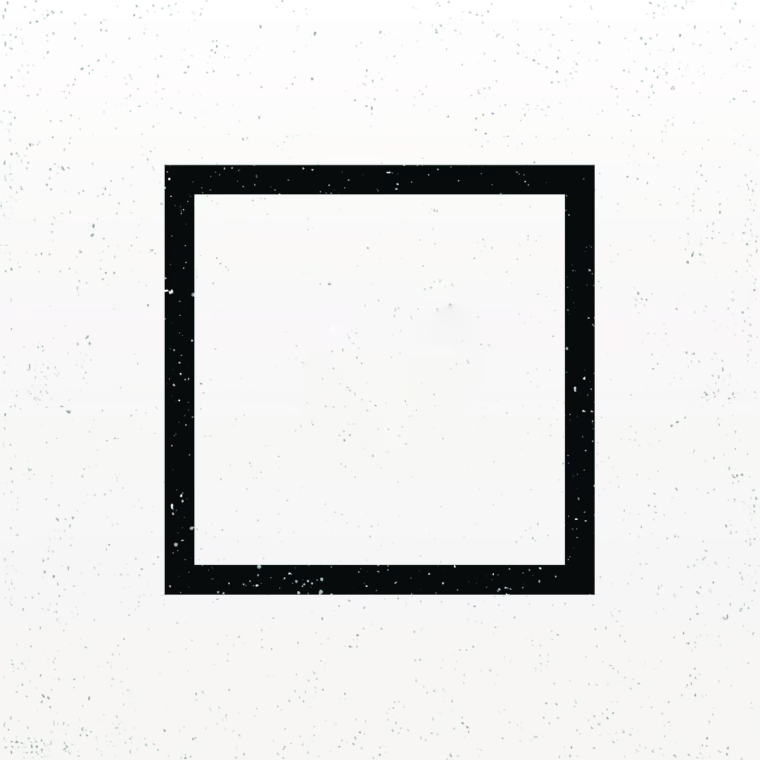
What meanings came to mind? Perhaps you thought of geometry, the four corners of the earth, a window, or a sacred altar. You may have thought of equality or stability, or perhaps you simply saw it as a shape on a screen with no meaning at all.
Outside of any context, a symbol, shape, or whatever is meaningless. It must first be given meaning, and then that meaning must be communicated through a context that allows interpretation. Without context, symbols are like a language with no grammar or sound.
That brings us to the first principle of symbolism: symbols require context in order to communicate ideas.
Think about how the English alphabet works. If I gave you a pile of letters and asked what they meant, you would have no idea. But if I arranged those letters into words, and the words into sentences, communication would happen. The meaning is not in the letters themselves, but in the order and relationship they share within a particular context.
At times, we want to communicate a very specific meaning, so we use precise language.
We might underline a word, bold it, italicize it, or even color it red to emphasize its importance. At other times, we wish to invite interpretation and reflection, so we use forms of expression that are more fluid and open-ended. Art, music, gestures, and parables fall into this category.
Both types of communication have a place. Sometimes the Lord speaks in absolute terms, giving us clear definitions and boundaries. Other times He teaches through symbols that allow for deep, personal introspection.
The Role of Context
Context determines meaning. It can make a symbol flexible enough to carry many interpretations, or it can fix a symbol to a single, defined idea. Context also determines whether meaning is subjective or objective.
- Subjective meaning is based on personal experience, insight, or feeling.
- Objective meaning is independent of personal interpretation and is established by divine or external authority.
Many of Jesus’ teachings have a subjective quality. They convey an overall truth but leave room for the Spirit to teach each listener according to their capacity, experience, and need.
For example, in Matthew 10:16, Jesus told His disciples, “I am sending you out like sheep among wolves. Therefore be as shrewd as snakes and as innocent as doves.”
No further explanation is given in the text, yet the meaning is profound. Perhaps there was cultural context that made the statement clearer to those who first heard it. But for us, it invites meditation.
What does it mean to be a sheep among wolves? What does it mean to be shrewd yet innocent? Each person can explore the symbol and find a deeply personal application.
In other cases, Jesus removes ambiguity. When explaining the parable of the sower, He defines each symbol plainly:
“Listen then to what the parable of the sower means: When anyone hears the message about the kingdom and does not understand it, the evil one comes and snatches away what was sown in their heart. This is the seed sown along the path.”
(Matthew 13:18–19, NIV)
Here the meanings are fixed by divine explanation. The seed, the soil, the thorns, and the birds are all given specific interpretations by the Lord Himself.
This reveals something important. The entire spectrum between fluid and fixed meaning is not only valid, it is necessary for effective communication. Both serve divine purposes.

The Nature of Symbols: Fluid and Fixed
When we discuss symbols, people often want to know what a particular one “means.”
Debates can grow heated as individuals insist that their interpretation is the correct one. But this assumes that symbols are rigid and absolute.
In reality, symbols are alive because of the subjectivity of the meanings people impose upon them. These meanings move, shift, and grow according to the light they are given. A symbol may carry a fixed meaning in one context and a fluid meaning in another. A dove might symbolize peace in one instance and the Holy Spirit in another. Neither meaning cancels out the other; the context determines which applies.
A common mistake is to assume that every symbol has a single fixed meaning for all times and all places.
But God speaks through living language, not static definitions. The power of symbolism lies in its capacity to adapt and reveal deeper truth through multiple layers of meaning.
The Four Qualities of Symbolism
To help organize these ideas, I find it helpful to think of four qualities that govern how symbols function:
- Internal – Meaning that arises from within, through personal revelation or reflection.
- External – Meaning that comes from outside, established by God, scripture, or authorized servants.
- Fluid – Meanings that shift with context, experience, or interpretation.
- Fixed – Meanings that are consistent and unchanging within a given context.
From these qualities, we can identify four categories of symbols:
- Internal Fluid: Personal impressions that change and evolve as understanding deepens.
- Internal Fixed: Private insights that remain constant once received through revelation.
- External Fluid: Divine or scriptural symbols that take on new layers of meaning depending on context, such as water, light, or fire.
- External Fixed: Divinely established symbols whose meanings remain the same, such as ordinances, covenant marks, or divinely interpreted parables.
Understanding which type of symbol you are dealing with prevents confusion and promotes humility. It helps you recognize that your interpretation may be personal and not necessarily universal.

The Harmony Between Fluid and Fixed
Some may see fluidity and fixity as opposites, but they are actually partners. Fluid symbols allow revelation to be personal and dynamic. Fixed symbols anchor that revelation so it does not drift into chaos or misinterpretation.
All symbols are fluid in potential, but any symbol can become fixed depending on its context. Context governs meaning, and meaning is always in relationship to purpose. A hammer can be used to build or to destroy, but its essence as a tool remains the same. So it is with symbols.
Even the most constant symbols, such as the bread and wine of the sacrament, carry additional layers of fluid meaning that unfold with personal spiritual growth. The meaning is fixed in its core doctrine but fluid in its depth of application.
Learning to Read God’s Language
Symbols are the language of heaven, and they are everywhere. The temple, the scriptures, the natural world, and even our own experiences are filled with them. The more we learn to recognize and interpret these symbols, the more fluent we become in the divine tongue.
When studying a symbol, ask yourself:
- Who assigned this meaning?
- What is the context?
- Is it meant to teach me something universal or something personal?
- Is the meaning consistent throughout scripture, or does it vary?
Approaching symbols in this way transforms study into revelation. It allows the Spirit to teach according to your readiness, just as Christ’s parables concealed truth from the unprepared but revealed it to those with eyes to see and ears to hear.

The Living Word
I once believed that every symbol must have a single, final meaning. I thought that if I could just find the correct interpretation, I would unlock the mystery once and for all. But I came to understand that the living word of God is not a dictionary of dead definitions. It is a conversation between heaven and earth, between the eternal and the temporal.
Finality can rob us of discovery, but context restores purpose to our searching. God does not hand us fixed maps; He gives us living patterns.
In the end, all true symbols point to the same source. As Nephi wrote, “I beheld the Lamb of God, that he was taken by the people; yea, the Son of the everlasting God was judged of the world.” Every symbol whether fluid or fixed, internal or external, ultimately belongs to God and can glorify Him and His creation.

2 Comments
How goes your study on King Mormon and Mosiah 18? I think I know something about this but I’m interested if you concluded anything. Before I saw your interview on the stick of Joseph, I was studying this. I’m leaning into the idea that Mormon is a Jaradite name. Linked to Jacob 7 and their efforts to ‘reclaim’ the ‘lamanites’
Good question. Yeah, after that show, I did some more digging and I found some cool stuff. I think Mormon is a Jaredite name as well, I wrote a post about it here that you may have missed: https://oneclimbs.com/2025/06/03/was-the-land-of-mormon-named-after-someone-if-so-who/