

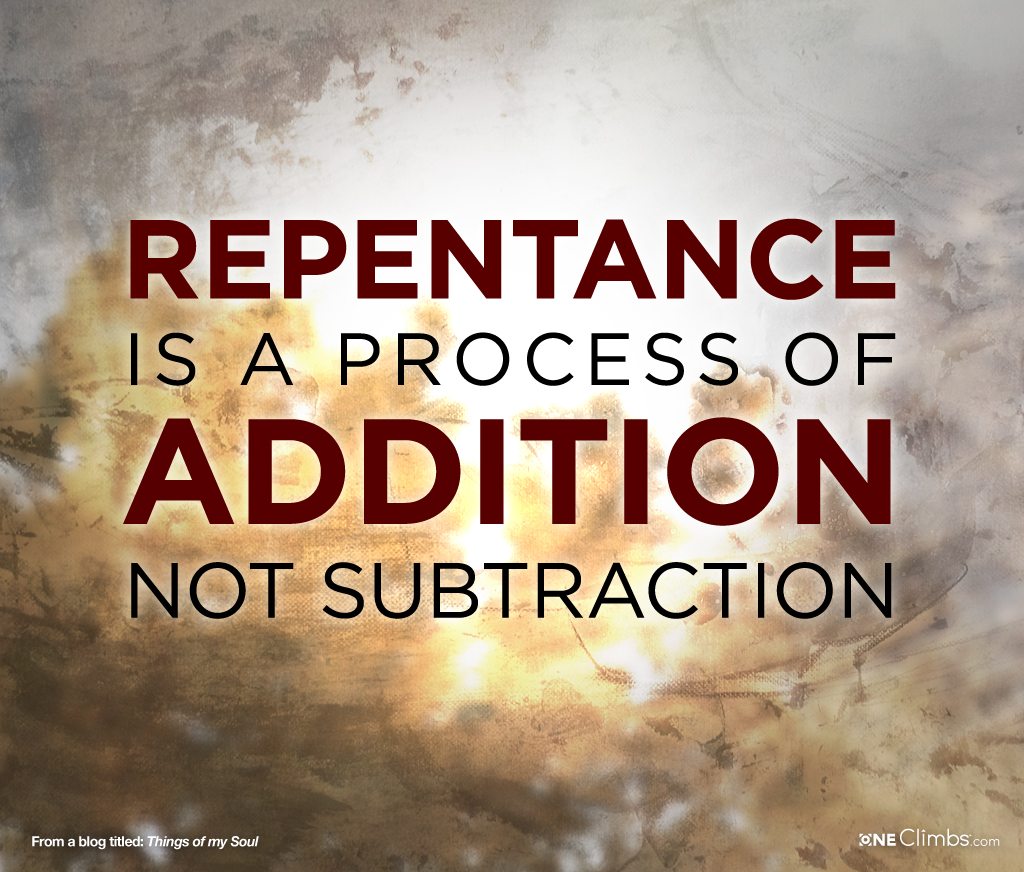
I came across this post the other day that had some interesting perspectives on repentance. How many Saints are focused way too much on the “subtraction” aspect of the repentance process? How many are locked in guilt-laden cycles focused on ceasing behavior instead of receiving the power of grace?
“[Repentance] is a process of addition – not subtraction. It is a process of acquisition, not elimination…You repent by ceasing to try to lessen who you are and allowing [Christ] to increase who you are. In short, you repent by “losing yourself” and “finding yourself”.
From a blog titled: Things of my Soul by post author “Papa D” (some parenthesis removed)
I can testify that the principle of allowing Christ to increase you is true because I have experienced it. You are not saved merely by ceasing your iniquity; sin is sin and once committed, it condemns you without the mercy of Christ. Seeing as how we continue to sin all the days of our lives, we are continually at the mercy of the grace of Christ.
It is only by adding the atonement of Jesus Christ that salvation is found.
Thus all mankind were lost; and behold, they would have been endlessly lost were it not that God redeemed his people from their lost and fallen state. (Mosiah 16:4)
What do you think?
- What is your perspective on the atonement of Christ?

1 Comment
I agree wholeheartedly that the atonement of Jesus Christ is the only power that saves us. None of us can overcome sin by our own strength, and we remain continually dependent on His mercy and grace (see Mosiah 16:4).
At the same time, the Bible is very clear that true repentance includes not only receiving grace but also turning away from sin. Grace is not permission to continue in what Christ came to deliver us from.
As the apostle Paul wrote in Romans 6:1–2,
“Shall we continue in sin, that grace may abound? God forbid. How shall we, that are dead to sin, live any longer therein?”
Likewise, 1 John 3:6 teaches that abiding in Christ changes our pattern of life, and Hebrews 10:26 warns against willfully returning to sin after receiving the knowledge of the truth.
So I see repentance as both:
Receiving the enabling power of Christ’s grace (addition)
Intentionally turning away from sin (subtraction)
We are not saved by our perfection, but genuine repentance does produce a changed direction. As Jesus Himself said in John 14:15,
“If ye love me, keep my commandments.”
Grace empowers the change — but the change still matters.