

Close Menu
  • The One Climbs Show
    • YouTube
    • Apple Podcasts
    • Spotify
    • Show Posts
  • Topics
    • All Posts
    • The Book of Mormon
    • Atonement
    • Symbolism
    • Temple Prep
  • Study Tools
    • Book of Mormon Onomasticon
    • Etymology Dictionary
    • Hebrew 4 Christians
    • Lectures on Faith.com
    • LDSSymbols.com
    • Number in Scripture
    • Isaiah Explorer
    • ScriptureNotes
    • Strong’s Condordance
    • The Book of Isaiah (IIT)
    • Webster’s 1828 Dictionary
  • About
    • About oneClimbs
    • Contact
Trending
  • The Doctrine of the Gift of the Holy Ghost
  • My Jacob 2:30 peer-reviewed paper is live!
  • Advice to a new missionary: the olive tree
  • The Temple Endowment’s Ancient Blueprint – The Stick of Joseph
  • What did Nephi see with an eye of faith? – The Stick of Joseph
  • The NEW LDSSymbols.com
  • Huge LecturesonFaith.com Update April 2026!
  • Latter Daily Saints: Robot Teachers
oneClimbs.comoneClimbs.com
  • The One Climbs Show
    • YouTube
    • Apple Podcasts
    • Spotify
    • Show Posts
  • Topics
    • All Posts
    • The Book of Mormon
    • Atonement
    • Symbolism
    • Temple Prep
  • Study Tools
    • Book of Mormon Onomasticon
    • Etymology Dictionary
    • Hebrew 4 Christians
    • Lectures on Faith.com
    • LDSSymbols.com
    • Number in Scripture
    • Isaiah Explorer
    • ScriptureNotes
    • Strong’s Condordance
    • The Book of Isaiah (IIT)
    • Webster’s 1828 Dictionary
  • About
    • About oneClimbs
    • Contact
oneClimbs.comoneClimbs.com
Home»Articles»Beautiful Literary Patterns in Alma 19:6
Articles September 13, 20154 Mins Read

Beautiful Literary Patterns in Alma 19:6

image

I was doing a search today in the Gospel Library app for the word “mind” because I was looking for particular themes related to the mind in the Book of Mormon. As I looked at Alma 19:6, the repetition of the word “light” was clued me in that there must be some literary structure at work.

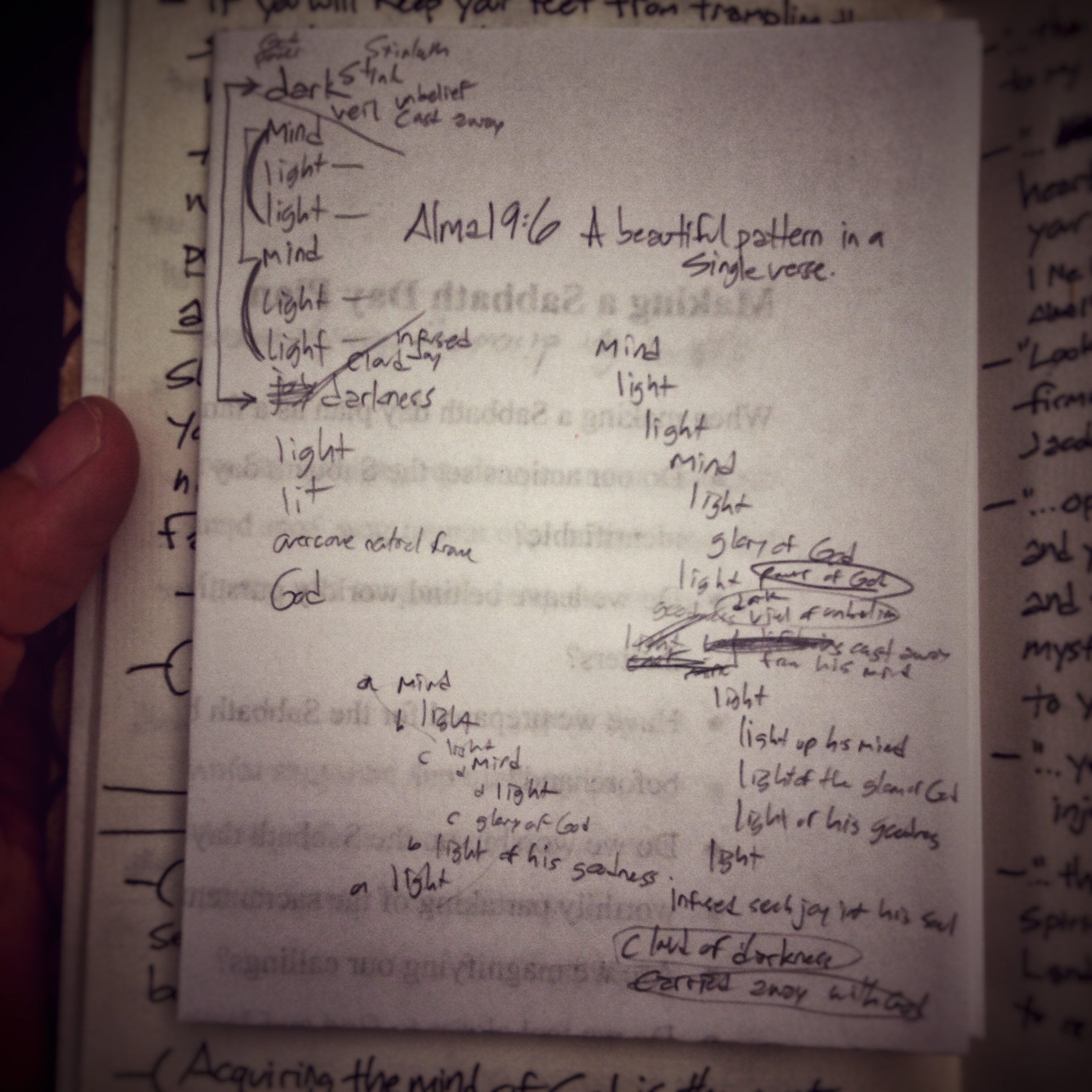
In ancient Eastern languages without punctuation, you painted pictures through repetition, emphasis, contrast, and many other techniques. I have broken down Alma 19:6 based on various patterns, the most obvious being an overarching chiasm and various sets of parallelisms. There are a couple of different ways you can read this depending on the theme being emphasized.

  • A1 – he knew that king Lamoni was under the
  • A2 – power of God; he knew that the
    • B1 – dark veil of unbelief was being
    • B2 – cast away from
    • B3 – his mind, and the
      • C1 – light which did
      • C2 – light up his
      • C3 – mind, which was the
        • D1 – light of the glory of
          • E – God, which was a marvelous
        • D1 – light of his goodness–yea, this
      • C1 – light had
      • C2 – infused such joy into his
      • C3 – soul, the
    • B1 – cloud of darkness having been
    • B2 – dispelled, and that the light of everlasting life was lit up in
    • B3 – his soul, yea,
  • A1 – he knew that this had overcome his natural frame, and he was
  • A2 – carried away in God–

The entire thought presented here is surrounded by the name of God, who appears at the beginning and the end (how appropriate). Next is this dark veil or cloud of unbelief which was preventing the light of God from shining through. This light that comes from God lights up or infuses joy into the mind and soul. This light is called the “light of the glory of God” and the “marvelous light of his goodness.”

The word “light” appears six times, seven if you include God himself at the center with three mentions of light preceding and proceeding his name.

  • light
    • light
      • light
        • God
      • light
    • light
  • light

We also have the contrasting themes of:

  • the dark veil of unbelief
  • the light of everlasting life

Here’s another less complex way to structure things that shows how the language changes a little after the crux of the chiasm.

  • A – he knew that king Lamoni was under the power of God; he knew that the
    • B – the dark veil of unbelief was being cast away from his mind,
      • C- and the light which did light up his mind,
        • D – light of his goodness–yea, this which was the light of the glory of God, which was a marvelous
      • C – light had infused such joy into his soul,
    • B- the cloud of darkness having been dispelled, and that the light of everlasting life was lit up in his soul,
  • A – yea, he knew that this had overcome his natural frame, and he was carried away in God–

First we see the mind as the focus and then it is the soul. A dark cloud or veil over the mind prevents one below from seeing the light of God above, much like a cloud blocks out the sun. After it is cast away or dispelled, then the light of God comes in from above filling the entire soul below, the mind, body, spirit, intelligence, etc.

These are just the few ways that 99 words in a single verse of scripture can be explored by looking at literary structures. These kinds of things are all over the place in the Book of Mormon, and I love it when I find a good one like this.
image

Book of Mormon Chiasmus Light The Mind of God The Spirit
Previous ArticleShort Film: Discovering the Word of Wisdom
Next Article “Who has known the Mind of the Lord?”
Steve Reed

I created oneClimbs as a place to organize my thoughts and share my observations with anyone who might find the information useful. Though I may speak passionately or convincingly in some of this content, PLEASE don't simply take my word alone on anything. Always seek the truth of all things through study and prayer in the name of Jesus Christ.

Leave A Reply Cancel Reply

New Post Email Notifications

New post updates go out every Saturday morning only if there is something new. Your email is never shared and you can unsubscribe any time.

POPULAR POSTS
  • Popular
  • Recent
Recent Comments
  • Shadrack on The Meaning of Isaiah 4:1 and Seven Women Taking Hold of One Man: “Surprisingly Jesus said in heaven issues of marriage won’t be recognized so I think what we need is to concentrate…”
  • Steve Reed on My Jacob 2:30 peer-reviewed paper is live!: “Thanks for all of your help, it was a great experience all around.”
  • Tiani on My Jacob 2:30 peer-reviewed paper is live!: “Very nice words, Steve. It was terrific working with you, and we’re thrilled that your paper is now officially published.…”
  • Steve Reed on Characteristics vs. Attributes: Demystifying Lectures 3 and 4: “Thanks Amanda, that is great to hear that your son is a new believer. Is he just beginning to be…”
  • Amanda Stanush on Characteristics vs. Attributes: Demystifying Lectures 3 and 4: “I absolutely loved your article and forwarded it to my son who is a new believer. It is a simple…”
Blogroll
  • A Traditional Architecture Glossary
  • Academy for Temple Studies
  • Book of Mormon Onomasticon
  • Bruce Charlton's Notions
  • Historical Monogamy
  • Interpreter Foundation
  • Isaiah Explained
  • Isaiah Explorer
  • Isaiah Institute
  • Isaiah Prophecy
  • Junior Ganymede
  • Latter-day Saint Architecture Blog
  • Latter-day Saint Temples
  • LDSSymbols.com
  • Leading Saints
  • Number in Scripture by E. W. Bullinger
  • Search tool for the Bible
  • Search tool for the Book of Mormon
  • Strongs Concordance
  • TempleStudy
  • The Ancient Context of Joseph Smith's Egyptian Alphabet and Grammar
  • Webster's 1828 Dictionary
oneClimbs.com
  • Home
  • All Posts
  • About oneClimbs
  • Contact

LecturesOnFaith.com  //  LDSSymbols.com

© 2026 oneClimbs. All content unique to oneClimbs is fair use. All other content is property of the respective copyright owner. oneClimbs.com is not owned, controlled, or affiliated with The Church of Jesus Christ of Latter-day Saints. All views and opinions are of the authors here who are solely responsible for their content and should not be interpreted as official statements of Church doctrine, belief, or practice, unless specifically stated and correctly referenced.

Type above and press Enter to search. Press Esc to cancel.