

Nephi’s vision in 1 Nephi 11 is one of my favorite parts of scripture, as it is for many others. I keep coming back to it over and over again because it does not explain itself all at once.
It has seemed to unfold to me more and more in stages as my knowledge has increased over time.
I have wondered for a long time who the “Spirit of the Lord” was that catches Nephi away and speaks with him on the mountain. It seems that this would be the third member of the Godhead often called the Holy Spirit or Holy Ghost, but lately I have observed some things in the text that lead me to believe that this is actually the second member of the Godhead, the Lord Jesus Christ.
I’ve got some receipts to back this theory up, so you’ll have to see if what I present makes sense. With that, let’s dig in.
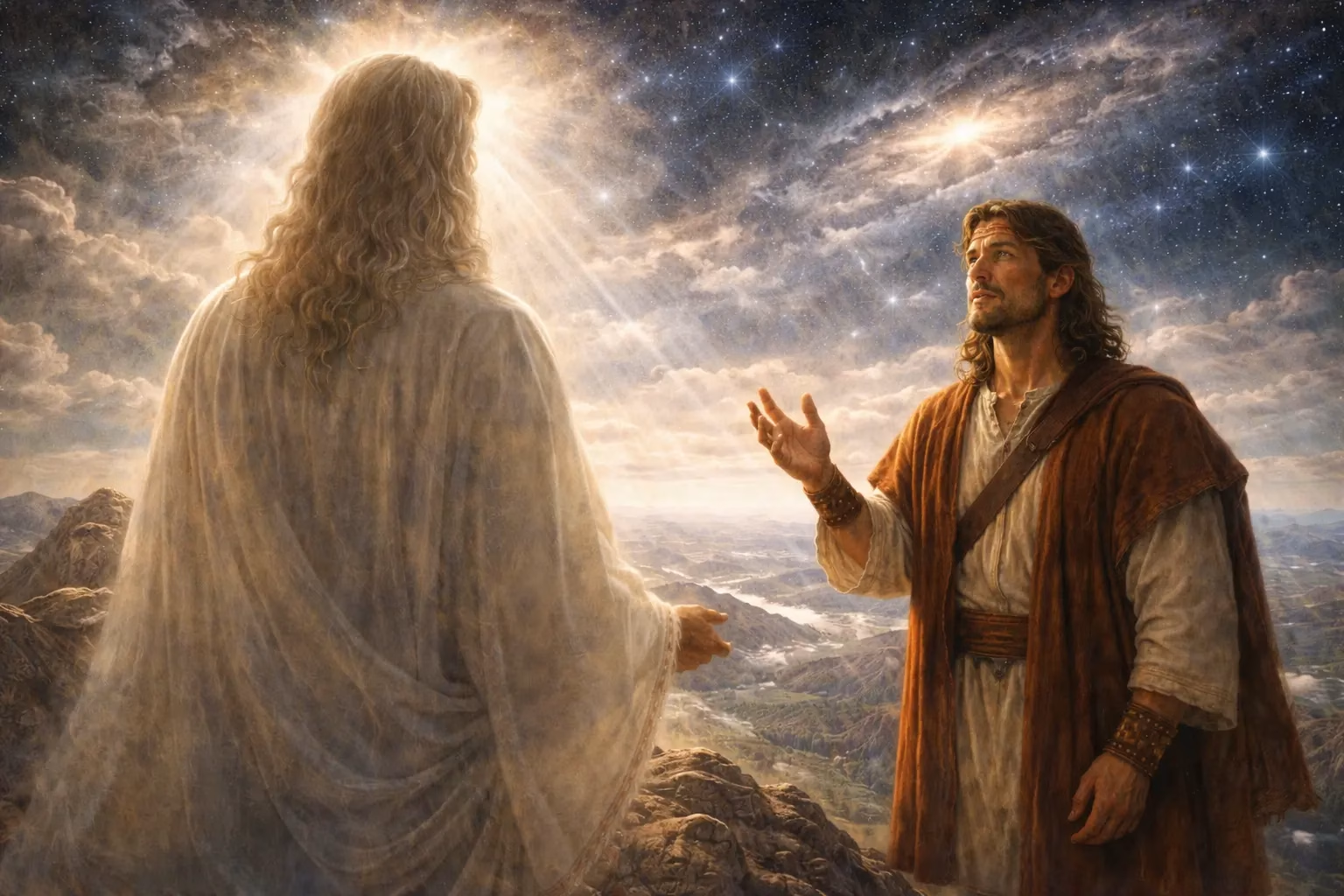
The vision begins with ascent and presence
Nephi is caught away by the Spirit of the Lord to a high mountain. This is not incidental scenery. In ancient scripture, mountains are not neutral locations, they are consistently the places where heaven and earth overlap so that divine presence becomes accessible.
On that mountain, Nephi encounters the Spirit of the Lord as a conversational presence and in a form that is recognizable to Nephi as a man.
The Spirit of the Lord asks questions, listens, discerns, and directs Nephi’s attention. This is not described as an inward feeling or an impersonal force; it is a conscious encounter.
It’s important to note that this initial guide is not an angel, an angel appears later. The vision opens with a figure that Nephi identifies as the Spirit of the Lord, which if this is the Holy Ghost/Spirit, that would be highly unusual. There isn’t anywhere else in the scriptures that the Holy Spirit appears in a physical form, let alone in the form of a man.
We don’t know what Nephi understood about the Holy Spirit or what or who he understood the Spirit of the Lord to be. We could do a deeper dive into how a 600 B.C. Hebrew might have understood the term, it appears many times in the Old Testament. That aspect definitely deserves a closer look and I may update this post later in the future with those details.
I can say thus far that the closest thing to what Nephi experiences that I can find is Malak Yahweh, the Angel (or Messenger) of the Lord. This figure appears in human or human-like form but repeatedly blurs into Yahweh himself.
When he appears to Hagar, Moses at the burning bush, Gideon, and Manoah (Samson’s father), the text shifts fluidly between “the angel of the Lord said” and “the Lord said,” as if they’re the same. Manoah and his wife believe they will die because they’ve seen God (Judges 13). It appears that this figure was a wrestled-over concept in ancient Jewish interpretation.
So that’s the first thing that makes me a little suspicious that something else might be going on here. The writers of scripture came from a world where they were big on patterns and if something stands out, it deserves a closer look.
Nephi’s orientation
The first exchange between Nephi and the Spirit of the Lord is about what Nephi desires and what Nephi believes. The questions are a type of initiation for Nephi and as I have examined them closely, some telling things appear.
Remember that Nephi has been caught up to an exceedingly high mountain which frames this in temple/ascent territory. Nephi is first asked asked “What desirest thou?” and “Believest thou that thy father saw the tree of which he hath spoken?”
Nephi is being aligned before he is being shown. This is an ancient pattern where revelation often begins with capacity, not information. The seer must be prepared to see rightly before the presentation is unveiled.
Note that at this point in the vision, Nephi has not been told what the tree represents and he has never seen the Spirit of the Lord or the Son of God. He does not yet possess the interpretive framework that would allow him to identify either.
The text is intentional about this. Nephi’s ignorance is staged and he is promised that he will see, not told that he already understands.
Presence Gives Way to Presentation
Then comes one of the most important moments in the vision. After being shown the tree, the Spirt of the Lord perceives that there is more that Nephi desires and asks again, “What desirest thou?”
Nephi wants to know the interpretation of the tree.
The Spirit says, “Look.” And when Nephi looks, the Spirit of the Lord departs instantly. But why?
I’ve never heard an explanation for this before, but I think I may have one now.
The Spirit of the Lord leaves Nephi’s presence, and an angel appears to take over as his guide. Immediately after, Nephi is shown Nazareth, Mary, and the child who is identified as the Son of God.
But more specifically, the angel says that what he is seeing here is “the Son of God, after the manner of the flesh” (1 Nephi 11:18) but what if that manner of speech is a subtle opposition to the Son of God after the manner of the spirit that Nephi has just experienced.
This transition is never explained, which means it is doing narrative work rather than doctrinal work. The question is why the guide must change at this exact point.
One possibility is procedural. The Spirit initiates the vision, and an angel handles the interpretation. That explanation can work, but it does not account for timing. Another possibility is more interesting and I think more faithful to the text’s structure.
Let’s lay out the sequence of events.
- Nephi is caught up.
- He is asked what he desires.
- He expresses his desire to see the tree.
- He is asked if he believes the words of his father.
- He answers affirmatively.
- He is told that he will see the tree and then he will see the Son of God.
- He is told to look and he does and sees the tree.
- He acknowledges that he sees the tree.
- He is asked a second time what he desires.
- He says that he wants to know the interpretation because he realizes that it is a symbol.
- At this point the Spirit of the Lord exits the the vision.
This shift is there for a reason, I think. This shift happens right between a vision of two things, the first is a beautiful tree and the second thing he sees after the Spirit of the Lord departs is a beautiful virgin. Here is how he describes each:
- Tree: “the beauty thereof was far beyond, yea, exceeding of all beauty; and the whiteness thereof did exceed the whiteness of the driven snow.” (1 Nephi 11:8)
- Virgin: “I beheld a virgin, and she was exceedingly fair and white…A virgin, most beautiful and fair above all other virgins.” (1 Nephi 11:13,15)
A connection is made between the tree and the virgin, they are the same thing. But up to this point, Nephi has not mentioned the fruit of the tree which his father mentions 18 times in his account. Nephi is going to see the fruit of the tree, but rather than the symbol, he’s going to see what the fruit represents: the Son of God.
Nephi is asked next: “Knowest thou the condescension of God?” (1 Nephi 11:16) Which is like asking, “What do you know about God lowering himself?” Nephi humbly expresses that he doesn’t know the meaning of all things but that he does know that God loves his children which accords with the sixth characteristic of God in Lecture 3, “he is love.”
Nephi is told that the woman that he sees “is the mother of the Son of God after the manner of the flesh.” (1 Nephi 11:18) And the next thing he sees is the virgin with a child in her arms.
The angel tells Nephi that this child is, “the Lamb of God, yea, even the Son of the Eternal Father!” (1 Nephi 11:21) and Nephi now understands the meaning of the tree.
I think this is why the Spirit of the Lord leaves, because I think Jesus shifts asking questions to answering them by embodying the one being revealed through narrative. The vision does not announce this shift, it simply performs it.
The tree reveals what Christ gives before Christ is revealed as a person. Love, life, joy, and covenantal fullness are placed at the center of the vision before identity is disclosed. Nephi encounters the meaning of Christ before the form of Christ.
If the Spirit of the Lord at the beginning of the vision is the pre-mortal Christ’s presence, then this sequence makes sense. Christ is revealed first through what he is, then through who he is, and only later through explicit titles.
Similarity in Brother of Jared’s encounter
The comparison of Nephi’s encounter with the Brother of Jared’s encounter sharpens the picture. In Ether chapter 3, the Brother of Jared also ascends a mountain. He also encounters a figure in the form of a man. But in that case, the Lord explicitly identifies himself as Jesus Christ and explains why he appears in that form.
The Brother of Jared and Nephi both came to the Lord to have a problem solved. Nephi specifically wanted to see the tree of life and understand it’s meaning. The Brother of Jared needed God himself to touch stones and give light to them.
While each of these encounters served a different purpose, what was being asked resulted in different experiences, but with who I propose was the same divine being.
Note how Nephi is asked twice, “What desirest thou,” (1 Nephi 11:2,10) which parallels what the Brother of Jared says to the Lord as he prays, “thou hast given us a commandment that we must call upon thee, that from thee we may receive according to our desires.” (Ether 3:2)
It’s also interesting to note that both Nephi and the Brother of Jared are asked specific qualifiers about their beliefs.
- The Lord to Nephi: “Believest thou that thy father saw the tree of which he hath spoken?” (1 Nephi 11:4)
- The Lord to the Brother of Jared: “Believest thou the words which I shall speak?” (Ether 3:11)
And in each case the answer was very interesting. Instead of a simple “Yes” in each case, the reasoning behind the affirmative response was bolstered by a knowledge concerning a specific characteristic or attribute of God.
- Nephi to the Spirit of the Lord: “Yea, thou knowest that I believe all the words of my father.” (1 Nephi 11:5)
- “Yea, Lord, I know that thou speakest the truth, for thou art a God of truth, and canst not lie.” (Ether 3:12)
Within these responses we can observe the following characteristics and attributes of God as described in the Lectures on Faith:
- Nephi is referencing the first the first attribute of God listed in Lecture 4: “First, Knowledge.”
- The Brother of Jared’s response mirrors the fourth characteristic from Lecture 3: “Fourthly, That he is a God of truth and cannot lie.” It also could be a reference to the sixth attribute of God as well from Lecture 4: “Sixthly, Truth.”
Lecture 3 teaches that, “three things are necessary, in order that any rational and intelligent being may exercise faith in God unto life and salvation.”
- First, The idea that he actually exists.
- Secondly, A correct idea of his character, perfections and attributes.
- Thirdly, An actual knowledge that the course of life which he is pursuing, is according to his will.
Since both Nephi and the Brother of Jared demonstrated a knowledge of these characteristics and attributes in their responses, it shows us that these principles are essential and can lead to the opening of revelatory doors.
Furthermore, the similarity in the inquiry and response adds to the evidence that this is the same being, Jesus Christ, interacting with Nephi and the Brother of Jared.
Patterns of meeting Christ first from other visions
Here’s another angle. Notice how Lehi’s vision is immersive. He walks, he fears, he eats, he invites; he is inside the experience looking outward.
Nephi’s vision is instructional. He watches, he is questioned, he is shown scenes, and he is taught how to interpret what his father experienced.
In both experiences, however, an unidentified guide is encountered at the beginning. For Lehi, it is a man in a white robe, and for Nephi he says it is the Spirit of the Lord.
I have speculated before that the man in the white robe could have been a deceptive figure; a false guide leading Lehi from a wilderness to a waste. With symbolism, several things can be true at once. You can use a particular model to teach many different ideas which is one of the reasons why symbolism is used in the first place. It’s also used to conceal and reveal as understanding evolves.
But what if Lehi’s guide is the Son of God as well? One argument against this idea would be why would Jesus lead Lehi into a waste? (Exploring answers to this question would require another detailed article in the future.)
Since the functions of the visionary encounters share similar symbolic elements but are experienced very differently, and perhaps Jesus manifests himself first at times to observe and guide, but also to test and challenge.
Lehi’s guide asks him to “follow him” (1 Nephi 8:6) which mirrors what the mortal Jesus asks of his disciples, “Follow me.” (John 1:43), and Nephi’s guide tells him, “And blessed art thou, Nephi, because thou believest in the Son of the most high God;” (1 Nephi 11:6) just like Jesus tells Thomas, “blessed are they that have not seen, and yet have believed.” (John 20:29)
Furthermore, in Lehi’s very first vision he encounters a figure that is likely Jesus descending out of heaven to give him a book. (1 Nephi 1:9-11) But doesn’t appear that Lehi recognizes this figure as Jesus the messiah at this point, or perhaps as the guide in his tree of life vision. Similarly, Nephi also does identify his first guide as Jesus but as “the Spirt of the Lord.” This could be because at that time, Nephi did not know the identity of the guide either.
It’s also important to note that Joseph Smith and Sydney Rigdon encounter Jesus first at the beginning of their vision, “For we saw him, even on the right hand of God; and we heard the voice bearing record that he is the Only Begotten of the Father—” (D&C 76:13-24)
We even see this in the New Testament where John’s vision begins with a dramatic encounter with the glorified Lord Jesus Christ, “And in the midst of the seven candlesticks one like unto the Son of man, clothed with a garment down to the foot, and girt about the paps with a golden girdle. His head and his hairs were white like wool, as white as snow; and his eyes were as a flame of fire;” (Revelation 1:13-14)
Parallels and patterns.
Conclusion
The text never states outright that the Spirit of the Lord Nephi encounters is Jesus Christ, but it also never denies it. What the text does do is carefully manage presence, sequence, and transition. The following facts are clear:
- The Spirit guides Nephi up the mountain.
- The Spirit converses with him personally.
- The Spirit departs at the moment the incarnation is shown.
- An angel replaces the Spirit as interpreter.
- Christ becomes the subject of the vision rather than the guide.
Taken together, these features allow, and perhaps quietly invite, the possibility that Nephi encounters Jesus first through presence, then through meaning, and only later through narrative embodiment.
To me, this is a reminder that scripture often reveals identity not by announcement, but by allowing us to see long enough that recognition becomes inevitable.

2 Comments
I’ve come to the same conclusion. The title “Spirit of the Lord” is used. At this time Christ is not embodied and is a spirit. And Christ is our lord.
In the original text written in reformed Egyptian this word must be different than the symbol for Holy Ghost which was used by Nephi one verse prior in Ch 10:19, 22. These two chapters were originally one narrative and Nephi is using two separate characters to refer to two different beings.
One character identifies with the Holy Ghost and the other character identifies with this being, the Lord in spirit form. What you teach beyond this all adds to this conclusion.
I did a deep dive to see if there was any consistency to the usage of “the Spirit of the Lord” and “the Holy Spirit/Ghost” and I couldn’t find anything consistent. There are many titles for members of the Godhead in the Book of Mormon and those that seem to be related to the Holy Ghost or Spirit are seemingly used interchangeably. In a recent video I did on YouTube I showed some of the patterns as to how frequently certain terms are used, but in context across the text, the usage seems interchangeable.
That said, in more narrow contexts such as a vision or a particular sermon, there does appear to be distinctiveness to which title is used.
It’s possible that there may be some other mechanics at play or a gap in our understanding of how the many authors in the Book of Mormon perceived the Godhead and its members. We’ll have to keep searching.