

A few years ago I came across a footnote in the Church’s Gospel Topics essay Becoming Like God that stopped me cold.
In “The Place of Theosis in Orthodox Theology,” Andrew Louth describes Eastern Orthodoxy as focused on a “greater arch, leading from creation to deification” and feels that Catholic and Protestant theologies have focused on a partial “lesser arch, from Fall to redemption” to the exclusion of that whole (in Christensen and Wittung, Partakers of the Divine Nature, 35).
Becoming Like God
This is Eastern Orthodox theologian Andrew Louth describing how Western Christianity had essentially been telling an incomplete story focusing on what he called a “lesser arch” running from the Fall to redemption, while losing sight of the “greater arch” stretching all the way from creation to deification.
That idea sunk deep into my mind and never left; I even wrote a post about it.
The lesser arch, or the fall to redemption, is the story most of us grew up hearing: sin, atonement, forgiveness, and salvation.
It’s true and it matters, but Louth’s point is that it’s only half the story. The greater arch starts before the fall, before mortality even enters the picture, and ends not just with sins forgiven but with human beings becoming what God intended them to be all along: exalted participants in divine life.
In LDS theology, we have language that emphasizes two parts of a greater whole. We talk about the Aaronic and Melchizedek Priesthoods, we talk about the Son and the Father, the chapel and the temple, and when we dig deeper, we discover themes of rebirth and coronation. Over time I started mapping these two arches onto a lot of things, and a rough outline emerged:
The Lesser Arch moves from the fall toward redemption. I see a potential association with the Aaronic order: preparatory, purifying, focused on the Son and his atoning sacrifice. The central ordinance is baptism, which is explicitly an ordinance of rebirth. The blessing promised is salvation.
The Greater Arch moves from creation toward exaltation. I see a potential association with the Melchizedek order: the fullness, focused on the Father and the eternal destiny of his children. The central imagery is coronation: becoming heirs, receiving all that the Father has. The blessing promised is exaltation.
I’ve found these two arches quietly threading through scripture in a lot of places. But recently, while doing a deep dive comparing Nephi’s vision (1 Nephi 11–14) with John’s Revelation, I noticed something that genuinely surprised me.
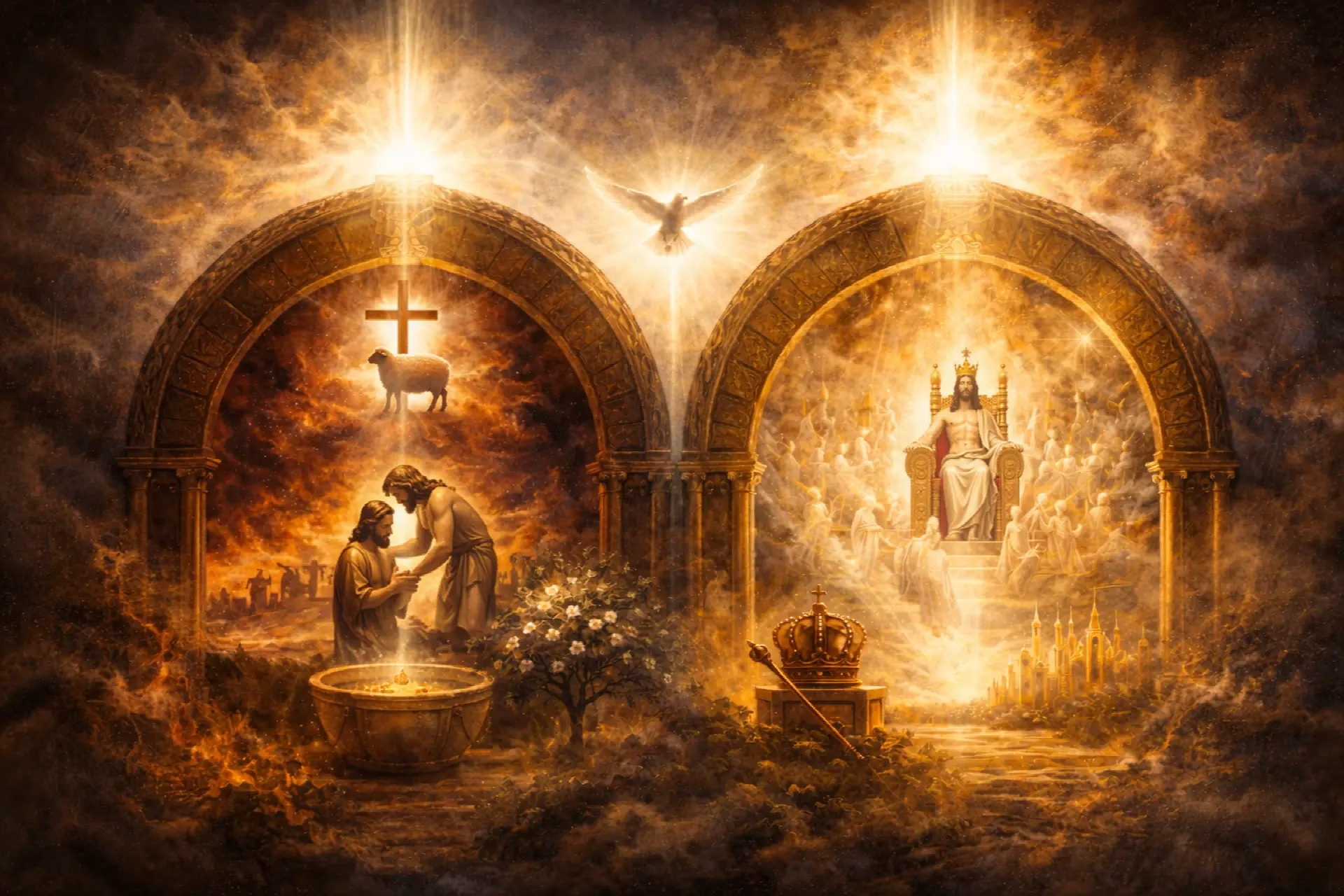
One Vision, Two Witnesses
The claim that Nephi and John saw the same vision isn’t speculative. Nephi states it directly. After his vision, he’s told:
“But the things which thou shalt see hereafter thou shalt not write; for the Lord God hath ordained the apostle of the Lamb of God [John] that he should write them.”
1 Nephi 14:25
And then the clincher: “
And behold, I, Nephi, am forbidden that I should write the remainder of the things which I saw and heard; wherefore the things which I have written sufficeth me; and I have written but a small part of the things which I saw.”
vs.28
So it’s explicit: same vision, two different reporters. Nephi got the first part. John got the second.
At first this might seem like an odd editorial decision. Why split one vision between two people? Why not have one prophet write the whole thing? But once you see what each of them is actually writing about, the division might make more sense on at least one level.
Nephi’s Christ: Birth and Rebirth
Nephi’s vision opens with the Tree of Life, then pivots to a sequence of events in Christ’s mortal ministry. The very first thing Nephi sees when the angel asks him to look is this:
“And it came to pass that I beheld that she was carried away in the Spirit; and after she had been carried away in the Spirit for the space of a time the angel spake unto me, saying: Look! And I looked and beheld the virgin again, bearing a child in her arms.”
1 Nephi 11:19-20
Christ enters Nephi’s vision as an infant, the condescension of God, the divine coming down into mortality, into vulnerability, into flesh.
Then, the very next time Jesus appears in the vision, he is being baptized.
“And I looked and beheld the Redeemer of the world, of whom my father had spoken; and I also beheld the prophet who should prepare the way before him. And the Lamb of God went forth and was baptized of him; and after he was baptized, I beheld the heavens open, and the Holy Ghost come down out of heaven and abide upon him in the form of a dove.”
1 Nephi 11:27
Jesus, in the first part of Nephi’s vision follows the pattern of the lesser arch: condescension, birth, and rebirth.
Nephi also sees the ministry of Christ and his atoning sacrifice for the sins of the world, to solve for the lesser arch, to redeem from the fall:
“And I, Nephi, saw that he was lifted up upon the cross and slain for the sins of the world.”
1 Nephi 11:33
There’s a reason Nephi’s vision emphasizes these things, he is writing before the Incarnation, Christ hasn’t come yet. For Nephi’s audience, his descendants across the centuries, the most pressing need is understanding who Christ is and what he will do when he arrives.
The lesser arch answers that question: he will come down, take on flesh, be baptized, suffer, and die for your sins.
John’s Christ: Coronation and Throne
Now walk into John’s Revelation and the contrast is almost jarring. Where Nephi opens with a humble virgin in Nazareth, John opens with this:
“I am Alpha and Omega, the beginning and the ending, saith the Lord, which is, and which was, and which is to come, the Almighty. […] And in the midst of the seven candlesticks one like unto the Son of man, clothed with a garment down to the foot, and girt about the paps with a golden girdle. And his feet like unto fine brass, as if they burned in a furnace; and his voice as the sound of many waters. His head and his hairs were white like wool, as white as snow; and his eyes were as a flame of fire;
Revelation 1:8,13-15
This isn’t a baby or even the mortal Jesus of the Gospels, this is a glorified, exalted, enthroned king. John sees Christ not in the manger but on the throne. Not in condescension but in coronation.
The coronation imagery only intensifies as Revelation progresses. Christ is declared the “King of kings and Lord of lords” (Revelation 19:16). He receives a crown (Revelation 14:14). He sits upon the great white throne of judgment (Revelation 20:11). The marriage supper of the Lamb, a royal banquet, marks the culmination of history (Revelation 19:9).
If Nephi’s vision gives us Christ entering the lesser arch (coming down to redeem), John’s vision gives us Christ completing the greater arch: exalted, having ascended, now reigning and bringing his saints into the same glory.
And this makes perfect sense given when John sees his vision. Nephi sees it before the Incarnation, John sees it after the Resurrection and Ascension. The work of the lesser arch is finished, and now John gets to see what comes next.
Why the Division Makes Sense
The split between the two witnesses isn’t random, it’s theologically necessary. The vision spans from the condescension of God in Nazareth all the way to the coronation of the glorified Christ and the exaltation of the saints.
That’s the entire story of God’s plan and intentions for his children, from the creation to the fall, to salvation and deification. God did something elegant here, it seems that he gave each prophet the portion of the vision that corresponded to their own historical vantage point and their own audience’s spiritual needs:
- Nephi, writing before Christ came, gave his people the lesser arch, what Christ would do, how he would come, why his sacrifice mattered. For a people who had never heard the Gospel preached and who would wait centuries for the Messiah, salvation from sin was the urgent message.
- John, writing after the Resurrection, gave his people the greater arch, what Christ’s exaltation meant for them, where history was heading, and what inheritance awaited the faithful. For a church already baptized and already redeemed, the pressing question was: what’s next?
Together, the two portions of one vision tell the complete story. Nephi’s half says: here is how God comes down to save you. John’s half says: here is where God is taking you.
A Pattern Lehi Also Saw
Before leaving this, it’s worth acknowledging an objection: if it’s one vision, why do different people see it so differently?
Just a few chapters before Nephi’s vision, we read about his father Lehi’s version of the same dream (1 Nephi 8). And Lehi’s experience is strikingly different, he begins “in a dark and dreary wilderness,” he’s a participant in the vision, wandering, following a guide, interacting with the landscape. Nephi, by contrast, is taken to “an exceedingly high mountain” and watches events unfold as an observer.
More telling is what each of them is most concerned with. Lehi’s primary focus is his immediate family, he watches for Laman and Lemuel, he calls out to Sariah and Sam and Nephi, his heart breaks over those who won’t come to the tree. It’s intimate and personal, and is about the salvation of the people in his immediate vicinity and time.
Nephi’s vision expands to cover centuries and nations. He sees the fall of his people, the Pilgrims, the Revolutionary War, the Restoration. His concern isn’t the family tent, it’s the entire sweep of history.
The same vision, but radically different experiences. Perhaps what you’re spiritually oriented toward shapes what you’re shown, and what you’re shown shapes what you write down. And God knowing all things, knows who should see and what they should write.
The Full Story
What strikes me most about all of this is how neatly it maps onto a theological problem that’s plagued Christianity for centuries: the tendency to tell only half the story.
Eastern Orthodoxy, as Louth notes, preserved the greater arch, the whole sweep from creation to deification, theosis, becoming partakers of the divine nature (2 Peter 1:4). Western Christianity, in both its Catholic and Protestant forms, largely collapsed the story into the lesser arch: sin, atonement, and forgiveness.
LDS theology, at its best, insists on holding both. We are saved from sin and we are being prepared for exaltation. The Atonement is real and it’s not the end of the story. The Son redeems us and the Father is preparing a crown.
In our chapels we perform the ordinances of the lesser arch. Many contain baptismal fonts where initiates are born again by water and anointed with the gift of the Holy Ghost, reflective of Nephi’s vision.
Temples, on the other hand, are where initiates participate in ordinances of the greater arch. They are washed with water and anointed with oil to become kings and priests, (Rev. 1:6) priests and priestesses to God, reflective of John’s vision.
Nephi and John, reading as a pair are two halves of a single extended vision and give us the complete picture. One tells us about the Lamb who was slain, the other tells us about the King on his throne.
You need both to understand what God is actually doing and what he has in store for us.
