

Note: The clue that led to the following article I owe to my good friend, Mike King. He explained the idea to me and I was so compelled by it that I had to go and see for myself, and this is the result of my analysis.
In the Book of Mormon, Nephi makes an unusual claim. After describing an expansive apocalyptic vision, he says he saw far more than he was permitted to record. The reason is explicit: another apostle was chosen to write that portion instead. That apostle is John, author of the Book of Revelation. (1 Nephi 14:23,25)
But how can he help his people understand the shape of history, the fate of the wicked, the fall of Babylon, the reign of the Messiah, and the final dwelling of God with His people? It seems that Nephi finds a solution to this problem without violating the restriction.
Rather than ending his record in silence in 1 Nephi 14, Nephi turns to Isaiah. In the chapters that follow, he appears to encode what he saw using Isaiah’s prophetic language.
This is not an argument for a verse‑by‑verse reproduction of Revelation, but for a selective use of Isaiah that parallels the same apocalyptic storyline Nephi saw and John would later write.
The proposition here can be outlined in three working assumptions:
- Nephi and John are independent witnesses to the same visionary drama.
- Both of them are downstream from Isaiah, who already set much of the symbolic vocabulary and revelatory imagery for the end‑time judgment and restoration.
- Nephi, constrained from writing everything he saw, leans heavily on Isaiah’s already‑authorized imagery to gesture toward those parts of his vision he cannot narrate directly.
What I’d like to propose here are seven core themes that are present between the Isaiah passages that Nephi includes in his record and John’s revelation. Consider this a mid-level take on this idea. Because large portions of two very complex books are being referenced, I’ll be providing references to chapters and not verses, that way you can read them side by side and compare for yourself.
To compare at a granular level would probably take a book or some kind of lengthy paper. It’s sufficient to my purposes for the time being to simply sketch out the idea and the correlations. With that, let’s dig in.
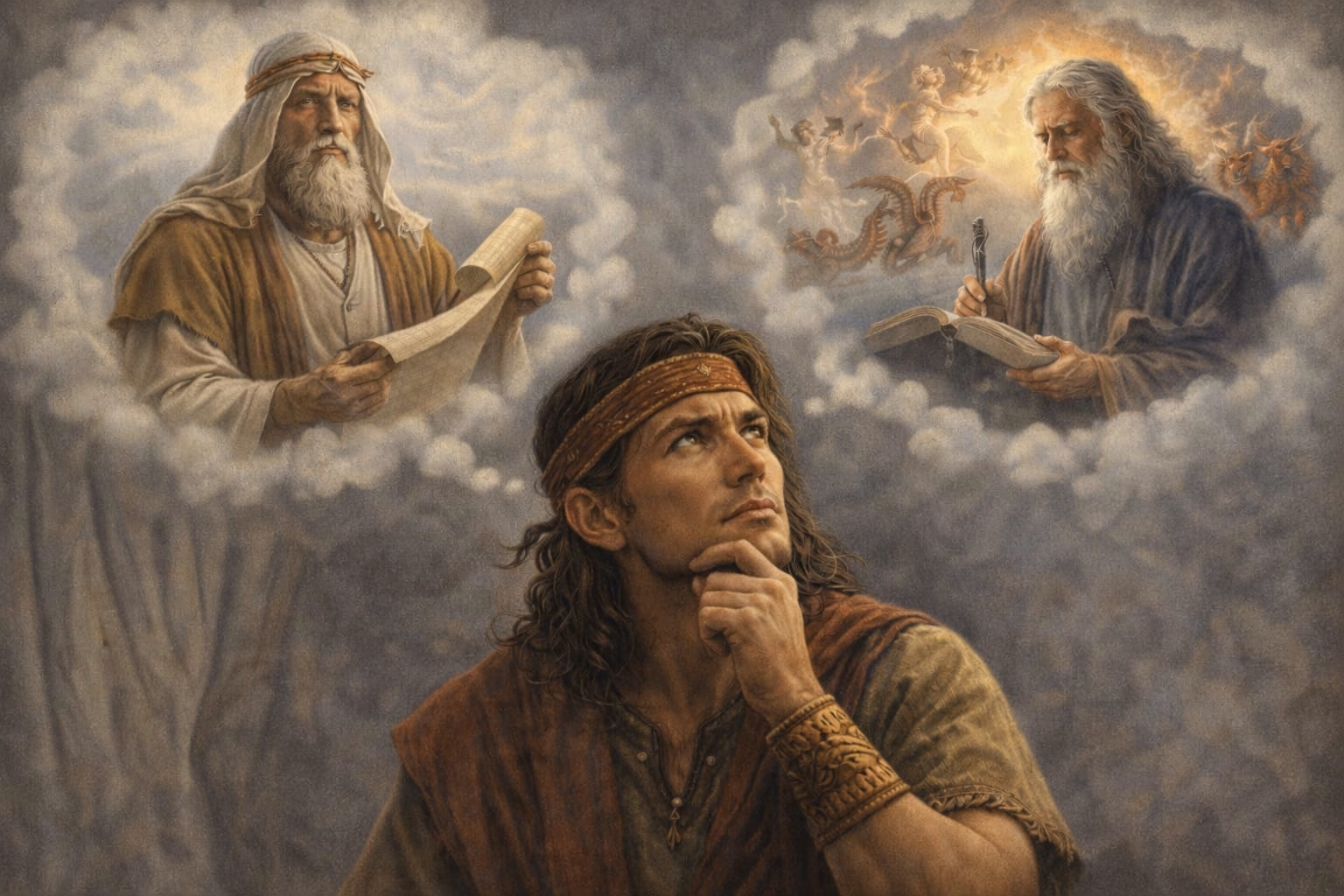
Seven core themes shared between Nephi’s Isaiah and the Book of Revelation
At a 10,000 foot view, Nephi’s Isaiah selections and Revelation trace the same covenant story arc with overlapping symbols, even though they differ in detail and genre.
1. Christ’s first coming and atoning work
- Nephi selects Isaiah passages that emphasize the Messiah’s birth, ministry, rejection, and redemptive power (for example, Isaiah 7–9; 11 as quoted in 2 Nephi 17–19; 21).
- Revelation does not retell the mortal ministry, but presupposes it, portraying Jesus as the slain yet victorious Lamb and faithful witness whose blood redeems people from every nation. (Revelation 1; 5).
Isaiah in Nephi bears witness that Jesus is the promised Davidic king and Savior; Revelation shows that the same crucified and risen Christ rules cosmic history and executes judgment.
2. Apostasy, blindness, and corrupting powers
- Nephi uses Isaiah to describe covenant Israel’s blindness and the corruption of latter‑day Gentiles and churches (especially Isaiah 2–4; 28–29 as quoted in 2 Nephi 12–15; 26–29). He applies this to pride, false security, and rejection of living revelation.
- Revelation portrays the great whore/Babylon, the beast, false prophets, and compromised churches as embodiments of spiritual adultery and corruption within and around God’s people (Revelation 2–3; 13; 17–18).
Both Nephi’s Isaiah and Revelation depict a long, dark phase of history marked by pride, false worship, and institutional corruption before final divine intervention. It’s important to note that “Babylon” and related images function more to us today as theological symbols of corrupt power than as simple labels for a single historical city or institution.
3. Judgment on nations and the fall of “Babylon”
- Nephi’s Isaiah draws heavily on judgment oracles where the Lord humbles lofty nations and brings down Babylon (Isaiah 2–4; 13–14; 24; 28–29 in 2 Nephi 12–15; 23–24; 27–30). He likens these to the downfall of end time world powers that fight against Zion.
- Revelation similarly sequences wars, plagues, and the final collapse of “Babylon the Great,” calling God’s people to “come out of her” before her destruction (Revelation 6–9; 16–18).
Isaiah’s pattern of divine judgment on arrogant and evil empires becomes, for Nephi and John alike, a kind of template for God’s eventual overthrow of the great and abominable global system that stands opposed to Christ and his people.
4. Scattering, gathering, and a covenant remnant
- Nephi uses Isaiah 10–12 and other verses to explain the scattering of Israel and the latter‑day recovery of a remnant by the Lord’s hand, including an ensign lifted to the nations and a second gathering (2 Nephi 20–21; 25–30).
- Revelation describes sealed servants from “all the tribes of Israel” and a countless multitude from every nation, as well as the “camp of the saints” preserved through tribulation (Revelation 7; 12; 14).
Both envision a faithful remnant preserved and gathered by God from among Israel and the Gentiles as history moves toward its climax.
5. Gentile era and final restoration
- Nephi reads Isaiah as outlining a “day of the Gentiles” when Gentile nations will receive the gospel, stumble, and yet play a role in restoring Israel, after which Israel’s promises are fully realized (2 Nephi 25–30). He broadly structures his own vision that way (Christ’s coming → Jews’ rejection → Day of the Gentiles → Restoration).
- Revelation likewise portrays a prolonged period of Gentile domination (“the nations” trampling the holy city), the preaching of the gospel to all nations, and then a final turning and judgment (Revelation 11, 14, 20).
Both see a long Gentile phase in salvation history that both blesses and judges the world before Israel’s full restoration and Christ’s open reign.
6. Zion, New Jerusalem, and God dwelling with His people
- Nephi’s Isaiah points toward the future joy and security of Zion: the Lord in her midst, nations flowing to God’s mountain, and everlasting covenant blessings (for example, Isaiah 2; 11–12; 49–52 as used in 1 Nephi 19–22; 2 Nephi 12–16; 6–10).
- Revelation culminates in the descent of the New Jerusalem, the dwelling of God with humanity, and the healing of the nations, which echoes Isaiah’s Zion language (Revelation 21–22).
The end of the story in both is not merely judgment but a holy community in God’s presence, enjoying inheritance, peace, and glory.
7. Prophetic books as “carriers” of a larger vision
- Nephi openly says he saw a sweeping apocalyptic vision but could not record the second portion because that role belonged to John. So, instead, he turns to Isaiah to “prove” and encode what he has seen (1 Nephi 14; 2 Nephi 11; 25).
- Revelation is explicitly that “second half” in Christian scripture: John writes what Nephi was forbidden to, using Israel’s prophetic vocabulary (especially Isaiah) to depict the same Christ‑centered outcome.
Nephi’s Isaiah and Revelation function together as two complementary lenses that both refract Isaiah’s earlier prophecies through distinct but converging end‑time visions focused on Christ, apostasy, judgment, remnant, and restored Zion.
A few examples of specific scriptural parallels
1. The sealed book
- “The vision of all is become unto you as the words of a book that is sealed” (Isaiah 29:11)
- “The book is delivered to him that is not learned… and he saith, I am not learned” (Isaiah 29:12)
- “I saw in the right hand of him that sat on the throne a book… sealed with seven seals” (Revelation 5:1)
- “No man in heaven, nor in earth… was able to open the book” (Revelation 5:3)
Nephi’s use of Isaiah 29 emphasizes God’s pattern of revealing and withholding, while Revelation 5 universalizes the sealed book as the Lamb‑held plan of God for history. While these scenes are not identical, both of them capture in symbol the same tension between sealed mystery and unveiled judgment.
2: Babylon and the world system
- “The burden of Babylon” (Isaiah 13:1)
- “Go ye forth of Babylon, flee ye” (Isaiah 48:20)
- “Babylon the great is fallen, is fallen” (Revelation 18:2)
- “Come out of her, my people” (Revelation 18:4)
Nephi never names Rome or beasts but he gives us Babylon in its prophetic grammar, knowing John will later expose it fully. Nephi sees how the wicked influence of this great and abominable church lead to the destruction of his people and threaten the destruction of the people in the last days. Nephi helps to identify many of its characteristics which provide a bridge between his vision and John’s.
3: Throne and authority
- “I saw also the Lord sitting upon a throne, high and lifted up” (Isaiah 6:1)
- “A throne was set in heaven, and one sat on the throne” (Revelation 4:2)
In both of these chapters, the vision of the throne is key. Judgement doesn’t just begin with events on earth but with a disclosure of who truly reigns over all.
4: The end state
- “New heavens and a new earth” (Isaiah 66:22)
- “The Lord shall be unto thee an everlasting light” (Isaiah 60:19)
- “I saw a new heaven and a new earth” (Revelation 21:1)
- “The Lamb is the light thereof” (Revelation 21:23)
Isaiah points toward Zion and Israel’s inheritance, while Revelation use the same language but looks forward to a fully renewed creation and New Jerusalem. Both accounts, in the end, acknowledge that the Lord will be the light of the new heaven and earth.
Why this is encoding, not coincidence
Three things make this intentional:
- Selectivity: Nephi does not quote Isaiah evenly, he selects apocalyptic Isaiah.
- Order: He arranges the passages covenantally, not historically, centering on sealed revelation.
- Explicit constraint: Nephi tells you he is restricted and tells you who will finish the record.
While other explanations are certainly possible, I think that these three factors point toward the conclusion that Nephi was indeed deliberately and selectively using Isaiah passages to gesture at things he was forbidden from revealing.
We can conclude that by doing things this way, that God observes the following:
- He reveals by authority
- He reveals in stages
- He reveals through stewarded texts
- He expects readers to recognize patterns across scripture
When Revelation finally appears on the scene to those who will have John’s words, Nephi’s readers will already know the terrain. They have been trained to recognize it through Isaiah.
This is why it is important to notice patterns in the text and pay attention to repetition and key words and phrases. They aren’t used randomly, but with the intent to pull together ideas from various other legitimate servants of God to open the eyes and expand the understanding of the reader.
The Isaiah that Nephi omits
The chapters Nephi omits tend to lack apocalyptic features such as:
- Throne visions
- Sealed books
- Cosmic uncreation
- Babylon-type world systems
- Global judgment
- Final divine dwelling with humanity
And those are precisely the topics that dominate John’s Revelation. Broadly speaking, Nephi is not cherry-picking favorite verses or simply quoting Isaiah randomly, he is filtering Isaiah by apocalyptic density.
But wait, there’s more!
There is another witness that could add another dimension to Nephi’s work. A companion to Nephi’s Isaiah passages is his brother Jacob who we may potentially include as a contemporary participant to Nephi’s work.
Nephi first quotes large portions of Isaiah to his brothers in the wilderness. He quotes two chapters of Isaiah (48-49) and then a number of verses in 1 Nephi 22 drawn widely from Isaiah chapters 5, 11, 13, 14, 29, 40, 49, 52, 60, and 66.
The next time we see Isaiah quoted is from Jacob in 2 Nephi chapters 6-9, where Jacob mirrors some of the Isaiah 49 that Nephi referenced in the wilderness years before, and then proceeds to quote the entire chapters of Isaiah 50 and 51 with a short reference to Isaiah 55:1-2 in 2 Nephi 9:50-51.
This lays a foundation for Nephi to pick up and deliver his densest quotations of Isaiah that begin in 2 Nephi 12. Does Jacob bring anything additional to the table with the particular passages of Isaiah that he quotes?
Jacob’s Isaiah intensifies the themes of covenant rescue, divine warrior power, cosmic un‑creation, and universal invitation, all of which show up again in Revelation’s middle and final chapters.
4. Scattering, gathering, and a covenant remnant
- Isaiah 49:22–26 (Jacob 5–6 context) is explicitly about Gentile kings and queens carrying Israel’s children, God rescuing “captives of the mighty,” and the world learning that the Lord is Israel’s Redeemer.
- Revelation echoes this with kings of the earth ultimately bringing their glory into the New Jerusalem and with the Lamb redeeming “out of every kindred, and tongue, and people, and nation” (Rev 5; 21).
Jacob underlines that the remnant theme is not just survival but vindication: oppressors are reversed, rulers serve Zion, and all flesh knows the Redeemer. That dovetails cleanly with Revelation’s “nations walking in the light” and “kings of the earth” motif.
3 & 5. Judgment, divine warrior, and Gentile era
Look at the cluster of images in Isaiah 50–51:
- Lawsuit language (“Who will contend with me? … Who is he that shall condemn me?”) anticipates Revelation’s courtroom/judgment setting.
- Cosmic signs (“I clothe the heavens with blackness,” 50:3; creation wearing out like a garment, 51:6, 8) parallel Revelation’s darkened sun, falling stars, and passing of heaven and earth.
- “Awake, awake, put on strength, O arm of the Lord… that hath cut Rahab, and wounded the dragon” (51:9–10) directly evokes a chaos‑monster/dragon combat, which Revelation will later narrate as the war against “the dragon, that old serpent, which is the Devil” (Rev 12; 20).
- The “cup of trembling” taken from Zion and given to her oppressors (51:17–23) anticipates Revelation’s “cup of the wine of the fierceness of [God’s] wrath” poured out on Babylon (Rev 16–18).
In Jacob’s chapters, we see Isaiah’s raw material for Revelation’s dragon, cosmic undoing, and cup imagery.
6. Zion, comfort, and new creation (Isaiah 51; 55)
- Isaiah 51:3–11 promises the comfort of Zion, wilderness turned to Eden, everlasting joy, and the redeemed returning with singing. That’s very close to Revelation 7; 21–22’s language of joy, tears wiped away, and paradisiacal restoration.
- Isaiah 51:16 speaks of planting the heavens and laying the earth’s foundations while declaring “Thou art my people,” linking new‑creation language with covenant identity.
- Isaiah 55:1–2 is the great universal invitation to come, drink, and eat without money, prefiguring Revelation 21:6 and 22:17’s “let him that is athirst come … take the water of life freely.”
Jacob’s citations highlight the final‑state side of the story: not only are enemies judged, but Zion is comforted, creation renewed, and all are invited to the messianic feast.
When we bring Jacob into the picture with Nephi we understand that:
- Nephi uses Isaiah primarily to frame the arc (Christ’s coming, apostasy, Babylon, judgment, gathering, Zion).
- Jacob then extends that same thread with servant, divine warrior, and invitation imagery that Revelation unmistakably picks up (dragon, cosmic signs, wrath‑cup, water of life).
So instead of Nephi alone encoding what he saw, it can be argued that Nephite prophetic tradition at this time (Nephi + Jacob) was curating Isaiah’s most apocalyptic and covenant‑heavy material in ways that align strikingly with Revelation’s use of Isaiah.
It also may reveal that Jacob may have seen the same vision that Nephi and John saw, or perhaps a part of it at least. Nephi said of Isaiah that, “he verily saw my Redeemer, even as I have seen him” (2 Nephi 11:2) and in the next verse he says, “my brother, Jacob, also has seen him as I have seen him” (vs.3) and that, “God sendeth more witnesses, and he proveth all his words.” (vs.4)
Nephi then proclaims:
Behold, my soul delighteth in proving unto my people the truth of the coming of Christ […] And also my soul delighteth in the covenants of the Lord which he hath made to our fathers; yea, my soul delighteth in his grace, and in his justice, and power, and mercy in the great and eternal plan of deliverance from death. And my soul delighteth in proving unto my people that save Christ should come all men must perish. […]
And now I write some of the words of Isaiah, that whoso of my people shall see these words may lift up their hearts and rejoice for all men.
2 Nephi 11:5-6, 8
Conclusion
Nephi did not record the second part of the apocalypse because he was forbidden from doing so. Yet he refused to leave his people, or us, staring into a blank space at the end of history.
By deliberately channeling his vision through Isaiah and standing alongside Jacob as a fellow witness, he turned an apparent restriction into a theological strategy: to teach the last days using texts God had already revealed and that he had within the brass plates.
Read this way, Nephi, Jacob, Isaiah, and John are not competing seers but participants in a single revelatory conversation. Isaiah supplies the original grammar of judgment, exile, remnant, and glory, while Nephi and Jacob curate its most apocalyptic phrases to map out the story they themselves have seen.
John then takes up the same lexicon to unveil the final movement. The continuity is not entirely obvious at first or mechanical, but I would argue, like my good friend Brother King that it is intentional.
The patterns traced here do not collapse Nephi into Revelation, or Revelation back into Isaiah. Instead, they invite us to read all three together and to recognize that God means His people to learn in layers: promise, vision, and then unveiled fulfillment.
If that is right, then Nephi’s Isaiah is not filler in the middle of his record; it is advanced training in how to recognize the voice of the Lamb when the last great book is finally opened.
“…in the days that the prophecies of Isaiah shall be fulfilled men shall know of a surety, at the times when they shall come to pass. Wherefore, they are of worth unto the children of men, and he that supposeth that they are not, unto them will I speak particularly, and confine the words unto mine own people; for I know that they shall be of great worth unto them in the last days; for in that day shall they understand them; wherefore, for their good have I written them.”
2 Nephi 25:7-8
Resources
If you would like to dig through my source texts and spreadsheets that I created to explore the connections between Nephi and John’s Revelations and the Book of Isaiah, you can access those files below on my Google Drive.
