

Close Menu
  • The One Climbs Show
    • YouTube
    • Apple Podcasts
    • Spotify
    • Show Posts
  • Topics
    • All Posts
    • The Book of Mormon
    • Atonement
    • Symbolism
    • Temple Prep
  • Study Tools
    • Book of Mormon Onomasticon
    • Etymology Dictionary
    • Hebrew 4 Christians
    • Lectures on Faith.com
    • LDSSymbols.com
    • Number in Scripture
    • Isaiah Explorer
    • ScriptureNotes
    • Strong’s Condordance
    • The Book of Isaiah (IIT)
    • Webster’s 1828 Dictionary
  • About
    • About oneClimbs
    • Contact
Trending
  • Advocate: God’s Character & Attributes Series
  • Where Blind Faith Ends
  • #44 – What’s With God and Boats?
  • A Covenant Lawsuit in Jacob’s Sermon to his People
  • The Deuteronomist Reforms and Lehi’s Family Dynamics: A Social Context for the Rebellions of Laman and Lemuel
  • Was the Spirit of the Lord Nephi Encountered the Premortal Spirit of Jesus?
  • Talk: The Earth, Christ, and Good Stewards of Creation
  • The Two Arches Hidden in Plain Sight: Nephi, John, and the Full Story of Christ
oneClimbs.comoneClimbs.com
  • The One Climbs Show
    • YouTube
    • Apple Podcasts
    • Spotify
    • Show Posts
  • Topics
    • All Posts
    • The Book of Mormon
    • Atonement
    • Symbolism
    • Temple Prep
  • Study Tools
    • Book of Mormon Onomasticon
    • Etymology Dictionary
    • Hebrew 4 Christians
    • Lectures on Faith.com
    • LDSSymbols.com
    • Number in Scripture
    • Isaiah Explorer
    • ScriptureNotes
    • Strong’s Condordance
    • The Book of Isaiah (IIT)
    • Webster’s 1828 Dictionary
  • About
    • About oneClimbs
    • Contact
oneClimbs.comoneClimbs.com
Home»Articles»Moses 6, Lecture 4, and The Attributes of God
Articles February 11, 20263 Mins Read

Moses 6, Lecture 4, and The Attributes of God

I was reading through Moses chapter 6 recently and when I got to the end of verse 61, I noticed something familiar. Toward the end of the verse are the 6 attributes of God as described in Lecture 4 of the Lectures on Faith.

Therefore it is given to abide in you; the record of heaven; the Comforter; the peaceable things of immortal glory; the truth of all things; that which quickeneth all things, which maketh alive all things; that which knoweth all things, and hath all power according to wisdom, mercy, truth, justice, and judgment.

Moses 6:61

Compare with the 6 attributes of God from Lecture 4:

  • Knowledge
  • Faith or Power
  • Justice
  • Judgement
  • Mercy
  • Truth

What stands out is that this developmental gap between Moses and the Lectures quietly exposes a function of the Holy Spirit that is often assumed but rarely stated with precision.
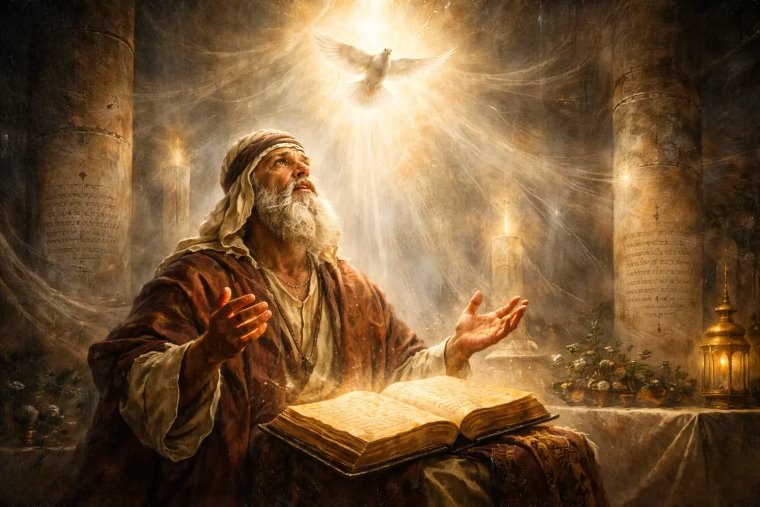
The Book of Moses emerges from Joseph Smith’s earliest revelatory period, (1830-1831) a time when theology is presented narratively rather than analytically. God is known by encounter, by voice, by covenant, and by transformation.

There is no attempt to catalog divine qualities. Instead, those qualities are imparted as men enter into relationship with God. Adam, Enoch, and their people do not study attributes; they acquire them through obedience, repentance, and reception of the Spirit.

By the time of the Lectures on Faith, (1834-1835) the question has shifted. The concern is no longer how God transforms humanity, but how faith itself operates. Lecture 4 does not attempt to list everything God is.

It isolates the attributes that must be trusted if faith is to function at all. These are not exhaustive qualities of God’s being. They are the minimum conditions for relational confidence.

This is where the Holy Spirit becomes decisive.

The Spirit does not merely inform man about God’s attributes. It reproduces them. As a person comes to know God’s character, attributes, and perfections, those same qualities begin to take shape within the believer through the gift of the Holy Spirit.

Faith bears fruit not because one assents to correct propositions, but because the Spirit is actively conforming the believer to the God in whom that faith is placed.

Seen this way, Lecture 4 is not abstract theology.

It is a diagnostic threshold. If these attributes are absent, faith cannot live. If they are present, faith grows because the Spirit is already at work, making the believer increasingly like the God they trust.

What Moses presents as lived transformation, the Lectures articulate as theological necessity. They are not competing visions. They are different lenses on the same divine process.

The Holy Spirit both reveals who God is and imparts what God is like, so that faith is not merely belief about God, but participation in His life.

Doctrine & Covenants Lecture 4 Lectures on Faith
Previous ArticleHow Nephi Encoded What He Was Forbidden to Write
Next Article Defining Wilderness, Waste, and the Field From Lehi’s Vision
Steve Reed

I created oneClimbs as a place to organize my thoughts and share my observations with anyone who might find the information useful. Though I may speak passionately or convincingly in some of this content, PLEASE don't simply take my word alone on anything. Always seek the truth of all things through study and prayer in the name of Jesus Christ.

Leave A Reply Cancel Reply

New Post Email Notifications

You can subscribe any time, and I will ONLY use your email to send you new post updates.

POPULAR POSTS
  • Popular
  • Recent
Recent Comments
  • William James Tychonievich on Approaching Truth, Keeping an Open Mind: “Packer’s quote — or rather the fact that the quote is widely known — has the unintended effect of undermining…”
  • Yinka Emmanuel on Repentance: a process of addition not subtraction: “I agree wholeheartedly that the atonement of Jesus Christ is the only power that saves us. None of us can…”
  • Steve Reed on Unlocking the Treasures of Alma’s Sermon to the Zoramites: “Very cool, I like what you have done here. I’ll have to look into how these patterns appear in sections…”
  • Steve Reed on Was the Spirit of the Lord Nephi Encountered the Premortal Spirit of Jesus?: “I did a deep dive to see if there was any consistency to the usage of “the Spirit of the…”
  • Dayne Grant on Was the Spirit of the Lord Nephi Encountered the Premortal Spirit of Jesus?: “I’ve come to the same conclusion. The title “Spirit of the Lord” is used. At this time Christ is not…”
Blogroll
  • A Traditional Architecture Glossary
  • Academy for Temple Studies
  • Book of Mormon Onomasticon
  • Bruce Charlton's Notions
  • Historical Monogamy
  • Interpreter Foundation
  • Isaiah Explained
  • Isaiah Explorer
  • Isaiah Institute
  • Isaiah Prophecy
  • Junior Ganymede
  • Latter-day Saint Architecture Blog
  • Latter-day Saint Temples
  • LDSSymbols.com
  • Leading Saints
  • Number in Scripture by E. W. Bullinger
  • Search tool for the Bible
  • Search tool for the Book of Mormon
  • Strongs Concordance
  • TempleStudy
  • The Ancient Context of Joseph Smith's Egyptian Alphabet and Grammar
  • Webster's 1828 Dictionary
oneClimbs.com
  • Home
  • All Posts
  • About oneClimbs
  • Contact

LecturesOnFaith.com  //  LDSSymbols.com

© 2026 oneClimbs. All content unique to oneClimbs is fair use. All other content is property of the respective copyright owner. oneClimbs.com is not owned, controlled, or affiliated with The Church of Jesus Christ of Latter-day Saints. All views and opinions are of the authors here who are solely responsible for their content and should not be interpreted as official statements of Church doctrine, belief, or practice, unless specifically stated and correctly referenced.

Type above and press Enter to search. Press Esc to cancel.