

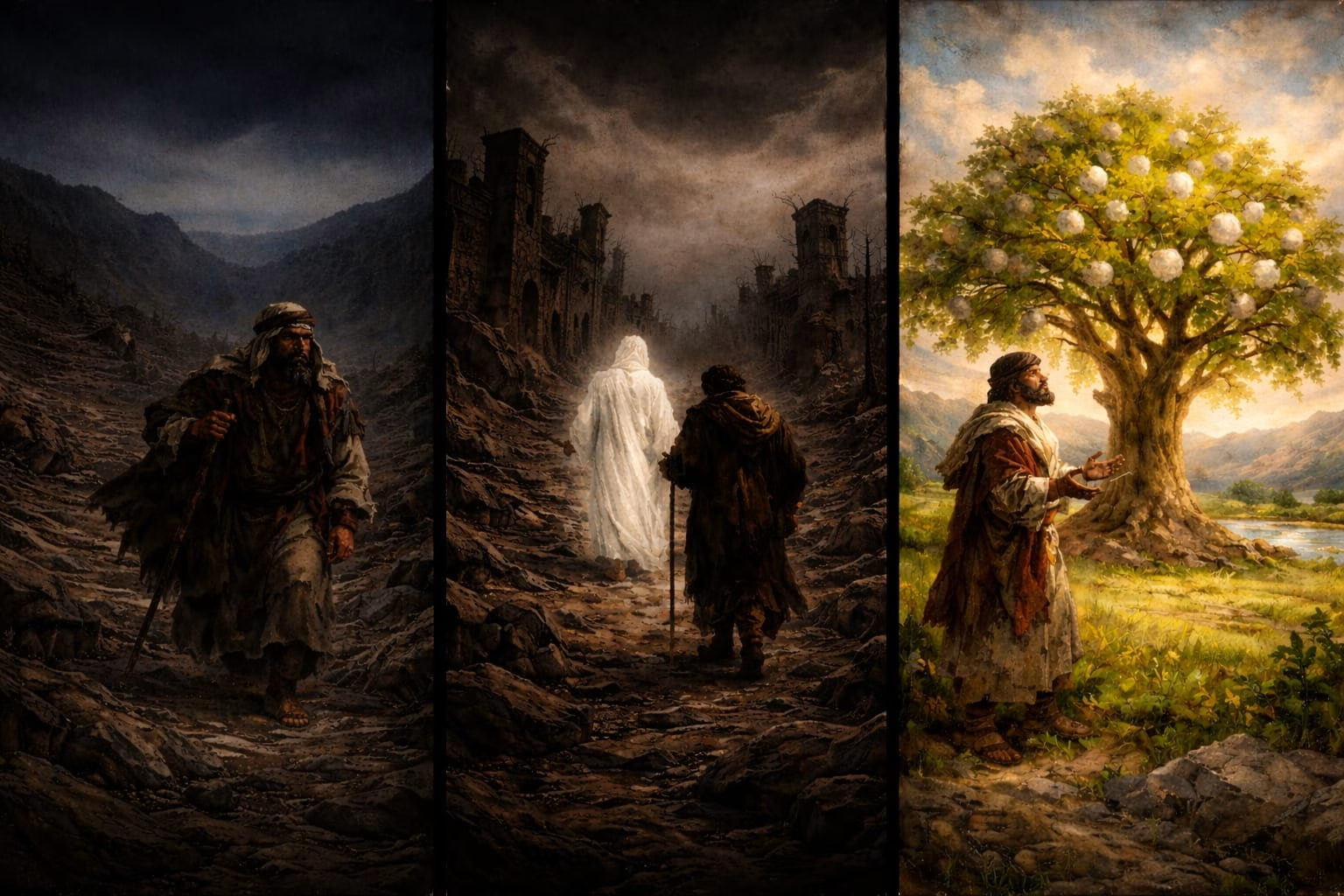
Lehi’s vision begins with a setting that mirrors his current circumstances. He finds himself in a dark and dreary wilderness, and by the time of this dream, he has already departed Jerusalem and taken his family into the wilderness.
“For behold, methought I saw in my dream, a dark and dreary wilderness”
1 Nephi 8:4
In Hebrew thought, the wilderness is consistently portrayed as a place of exposure and encounter.
It removes the stabilizing structures of society and leaves a person dependent on divine provision and guidance. Israel is formed there, prophets are refined there, and revelation often comes in that unsettled space where human security has been stripped away.
Darkness within the wilderness intensifies uncertainty and vulnerability, signaling disorientation rather than judgment.
Lehi’s presence in the wilderness establishes his prophetic posture. He is already separated from the city and its institutions, already listening for the voice of God, and already positioned within a space where testing and instruction occur.
Being Led Into the Waste
The vision then advances in a way that would have carried immediate theological weight for an ancient Hebrew audience. Lehi follows a man dressed in a white robe and gradually realizes that the landscape has changed into something more severe.
“And it came to pass that as I followed him I beheld myself that I was in a dark and dreary waste”
1 Nephi 8:7
In prophetic literature, a waste describes land that has undergone collapse, where order has unraveled and life can no longer be sustained. Isaiah repeatedly uses this imagery to describe Jerusalem after judgment, when cities stand empty, fields fail, and cultivated spaces revert toward chaos.
The waste Lehi sees aligns closely with prophetic descriptions of Jerusalem’s future. It reflects a land that once sustained covenant life and has now been reduced through collective failure. Lehi does not wander into this condition by chance. He is led there, potentially indicating that the scene functions as revelation to him rather than misfortune upon him.
This is important because as the vision continues we see Lehi continue to embody the vision from a first person perspective rather than observing from afar.
Prolonged Darkness and Uncreation
Lehi’s experience within the waste is marked by duration rather than immediacy. He travels for many hours in darkness without any relief or direction.
“And after I had traveled for the space of many hours in darkness”
1 Nephi 8:8
This prolonged exposure reflects a condition where movement no longer guarantees progress. In Hebrew theology, this resembles uncreation, where the ordered world of Genesis dissolves back toward emptiness. The waste is not simply difficult terrain; it represents a breakdown of the structures that make life fruitful and intelligible.
This portion of the vision corresponds naturally with prophetic warnings about Jerusalem’s destruction, portraying judgment as a return to chaos rather than an arbitrary act of punishment.
Prayer Born From Collapse
Lehi’s prayer emerges only after this extended exposure to the waste, and waiting for some kind of external influence to rescue him or provide further direction. He wanders and waits doing everything within his power but to no avail. It’s at this point which his frustrations turn him upwards toward God.
“I began to pray unto the Lord that he would have mercy on me, according to the multitude of his tender mercies”
1 Nephi 8:8
Lecture 3 teaches us that God is merciful and in Lecture 4 we learn that that one of his attributes, that which flows from God because of what he is, is mercy.
And again, it is equally important that men should have the idea of the existence of the attribute mercy, in the Deity, in order to exercise faith in him for life and salvation. For, without the idea of the existence of this attribute in the Deity, the spirits of the saints would faint in the midst of the tribulations, afflictions and persecutions which they have to endure for righteousness’ sake; but when the idea of the existence of this attribute is once established in the mind it gives life and energy to the spirits of the saints: believing that the mercy of God will be poured out upon them in the midst of their afflictions, and that he will compassionate them in their sufferings; and that the mercy of God will lay hold of them and secure them in the arms of his love, so that they will receive a full reward for all their sufferings.
Lecture 4:17
The prayer arises not at the onset of uncertainty, but after human capacity has been exhausted. Lehi does not pray for explanation or escape. He appeals to mercy grounded in God’s known character and attributes.
This moment marks the turning point of the vision, not because circumstances change immediately, but because the posture of dependence has fully formed.
The Field as Restored Order
Following his prayer, Lehi finds himself within a new landscape that signals renewal.
“And it came to pass after I had prayed unto the Lord I beheld a large and spacious field”
1 Nephi 8:9
A field represents cultivated land, shaped by labor and intention, and capable of sustaining life again. In prophetic imagery, restoration is often described through agricultural language, where waste places are replanted and life returns through cultivation rather than instant reversal. The field reflects order that has been reestablished enough to support growth.
This setting does not represent a return to Jerusalem as it once was, but the beginning of a reordered environment where fruitfulness becomes possible again. To Lehi, this may potentially point to the promised land.
The Tree and the Fruit of Restoration
Only within the field does Lehi encounter the tree and its fruit.
“And it came to pass that I beheld a tree, whose fruit was desirable to make one happy”
1 Nephi 8:10
The placement of the tree within the field communicates that lasting fruit emerges from restored order rather than from untouched wilderness or collapsed land.
The tree stands as the culmination of the vision’s progression, appearing after testing, judgment, and renewal have each played their role.
Lehi’s vision moves deliberately through these landscapes, weaving personal transformation, national prophecy, and cosmic pattern into a single narrative.
The wilderness prepares the soul, the waste reveals the cost of covenant failure, and the field marks the beginning of renewal where life can grow again.
The vision teaches that restoration does not bypass disruption, but moves through it, allowing fruit to emerge where order has been patiently rebuilt.
